
Through his first four starts, Ivan Nova has found himself as the poster boy for the “regression to the mean” debate. To some, his unsightly 5.18 ERA – which ranks third on the team among starters, by the way – and 1.48 HR/9 are demonstrative of his youth, or inconsistency, or lack of talent, or whatever reason one feels appropriate to explain away generally poor face value numbers. To others, Nova’s stellar 9.3 K/9, 1.9 BB/9, and 3.15 xFIP, coupled with a sky-high .421 BABIP and uncharacteristically high HR/FB (sitting at 14.8%) portend future success … and hopefully sooner, rather than later. Which side is correct?
In reality … neither. Yes, Nova’s ERA is likely to decrease, as his underlying performance has been quite strong – though, it should be noted that his groundball numbers are way down, from 52.7% last year to 42.5% thus far. Yes, many of those liners and bloopers that have led to high hit totals will find gloves next time around. However, Nova has also been hit pretty freaking hard thus far, allowing roughly 23.8% line drives (more than 5% above the past two years) and 33.8% fly balls (also 5% above the norm). FIP and xFIP do not quite adjust for this, so the true performance of Nova – that is, the performance our expectations should be predicated upon – lies somewhere in between.
In the field, it is quite a relief to see only one of Ibanez and Nunez roaming the outfield, and it is very nice of good ol’ Buck to start Mark Reynolds at the hot corner – a fine way to prod Mark Teixeira to go the other way.
Onto the line-ups:
| Baltimore Orioles | New York Yankees |
| Endy Chavez, LF | Derek Jeter, SS |
| J.J. Hardy, SS | Curtis Granderson, CF |
| Nick Markakis, RF | Alex Rodriguez, DH |
| Adam Jones, CF | Robinson Cano, 2B |
| Matt Wieters, C | Mark Teixeira, 1B |
| Chris Davis, 1B | Raul Ibanez, RF |
| Nick Johnson, DH | Eric Chavez, 3B |
| Mark Reynolds, 3B | Andruw Jones, LF |
| Robert Andino, 2B | Russell Martin, C |
| Jake Arrieta, SP | Ivan Nova, SP |
The first pitch is scheduled for 7:00 pm, on YES and ESPN – let’s go Yankees!
(The following is being syndicated fromThe Captain’s Blog; follow me on Twitter at).
Eduardo Nunez is a poor defensive player. Maybe one day his inner gold glove will finally shine through, but at this stage, his defense remains a serious liability. Considering all the supporting evidence, such a statement shouldn’t be controversial. And yet, for some reason, the Yankees’ brain trust of Brian Cashman and Joe Girardi not only seem unconvinced, but, on the contrary, apparently believe he is capable of playing just about every position. Not satisfied to endure his erratic defense in the infield, the Yankees have now cast Nunez as an outfielder, which, predictably, has already yielded worrisome results.
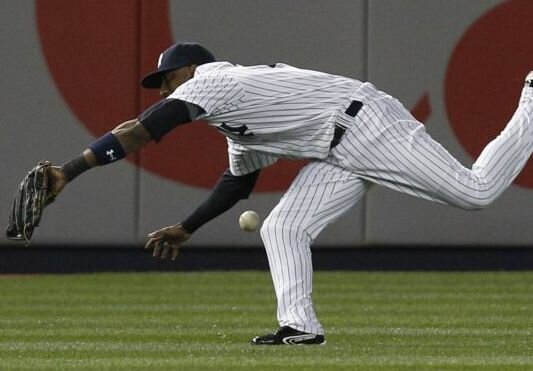
Nunez’ misplay of a fly ball in last night’s game cost the Yankees two runs. (Photo: AP)
The Yankees handling of Nunez is a classic case of a team desperately trying to shoe-horn a hitter into a defensive position so they can keep his bat in the lineup. The only problem, however, is Nunez can’t hit either (at least he hasn’t hit). In 431 plate appearances, the Yankees’ jack-of-all-trades has hit .268/.315/.375, which equates to an OPS+ of 84. In fairness to Nunez, his sporadic playing time might account for his subpar offensive numbers, but that doesn’t explain his struggles in the minors.
In six minor league seasons, Nunez came to the plate 2,772 times, compiling a line of .274/.318/.369, which is almost exactly the same as his major league output. At no point during his time on the farm has Nunez given any hint of developing into an above average hitter, so, once again, it’s difficult to understand the Yankees’ high expectations for him.
Another strike against Nunez is his relatively advanced age for a player with so many flaws. At 25, Nunez no longer qualifies as a prospect, making the Yankees’ commitment seem even more incongruous. Besides, how many players at his age, who have serious question marks about their glove and bat, manage to stick around in the majors, much less be given an important role on a championship caliber team?
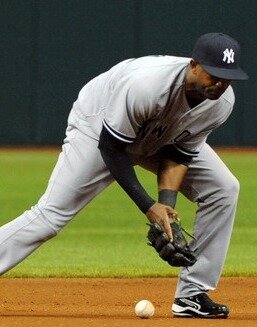
Earlier in the season, Nunez’ error on a ground ball proved instrumental in a loss to Tampa.
Eduardo Nunez seems like a nice guy and good teammate, which makes it difficult to offer a scathing review of his performance. However, it’s hard to look at his body of work and justify the way in which the Yankees have opted to use him. Granted, he does possess certain physical abilities, such as speed and a strong arm, but none of them have been developed to a major league standard. So, instead of allowing him to flounder with the big club, the Yankees and Nunez would be better served by a return trip to Scranton. After all, if Nunez really is a diamond in the rough, as the Yankees seem to believe, he should be able to sparkle at triple-A (something he has yet to do).
Cashman and Girardi aren’t strangers to occasional bouts of stubbornness, so maybe their steadfast support of Nunez is really an attempt to avoid admitting a mistake? If so, that strategy seems more likely to backfire because their insistence upon forcing him into a role, any role, is only serving to tarnish his reputation and, potentially, lower his confidence. Maybe Nunez will eventually fulfill the Yankees’ high expectations, but right now, he is only digging his hole deeper. At some point, Cashman and Girardi will have to own up their mistake because, only then, will they finally be able to help Nunez start to overcome his.
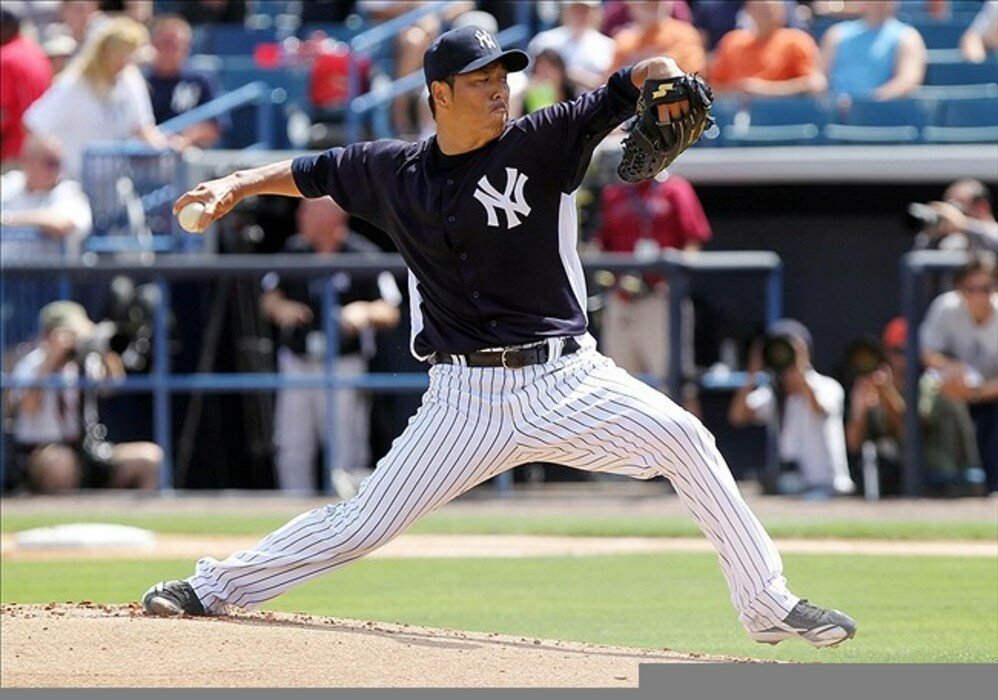
(Kim Klement-US PRESSWIRE)
has thus far been a very solid addition to the Yankees starting rotation. The 37-year-old right-hander, who spent the first four years of his Major League career in Los Angeles with the Dodgers, has made five starts on the young season. And though Kuroda is just 2-3 in those five starts, he has been arguably the most productive starter on the team. His 3.69 ERA leads all Yankee starters by nearly a run, the result of a home run rate far below the rates given up by the rest of the rotation.
So far, so good. And thank God. With out for the season and and sporting ERAs over 7.00, the acquisition of Kuroda is looking like a lot more than overkill. The second piece acquired on the same night as Pineda this past winter, Kuroda was seen as a luxury acquisition by some. Now, in the Yankees’ quest for a 28th title, Kuroda will likely be a major deciding factor.
Kuroda has pitched well. But five starts into the season, there is some reason to worry that age is catching up with the Japanese import. While some regression was to be expected, moving from the NL West to the AL East, Kuroda is now sporting a FIP and xFIP far above his career levels. After striking out 7.3 and 7.2 batters per nine innings in the past two seasons, respectively, Kuroda has just 20 strikeouts in his first 30.2 innings pitched. That’s a rate of 5.7 per nine innings. A normal drop for a pitcher making such a transition? Hardly. While the the pitcher in the National League provides strikeout fodder, the difference in K-rate between the National League in 2011 and American League in 2012 is, so far, just 0.2 strikeouts per nine innings pitched.
Kuroda has never been a strikeout pitcher, per se. His low walk rate and high groundball rates have kept his ERA firmly in the low-to-mid threes since joining the Dodgers in 2008. But even on those fronts, Kuroda has lost a step. Coming off a season in which he allowed well over a home run per nine innings – far above his career levels – some regression in that respect was expected. Kuroda’s groundball rate is up from last season, though still below his 2008-2010 levels. Moving from Dodger Stadium to Yankee Stadium hasn’t helped either. Kuroda has given up four home runs in five starts – two in one start at home, against the Minnesota Twins. Home runs hurt less without baserunners. But Kuroda’s walk rate, a career 2.1 per nine innings, sits just under 2.6 per nine. His strikeout to walk rate, generally int he threes and good indication of a pitchers ability to prevent baserunners, is just 2.2 on the season.
It’s early yet, but Kuroda’s deteriorating skill set does not look as much like a statistical fluke as a traditional aging pattern. Unlike Sabathia, among others, Kuroda does not suffer persistent slow Aprils. His caree ERA in the month is 3.19 and his velocity has generally been near his year-long average in the month. Yet so far this season, there is underlying underperformance. His fastball, which sat at 92.0 MPH last season, sits at 91.0 MPH so far this season, and he has thrown it about 5% less often. His breaking balls have similarly lost between 0.5 and 1.0 MPH. But Kuroda has thrown his slider 45% more frequently, his curveball twice as frequently. His swinging strike rate, around 10% for his career, is just above 8%. Kuroda is throwing fewer strikes, yet batters are making contact off more of his pitches, suggesting his stuff is suppressed and that Kuroda is less than willing to cave to hitters who are taking him deep at a career high rate.
Today is May 2nd, and May 2nd is always too early to get worried about anyone, let alone a pitcher with a 3.69 ERA. Yes, Kuroda has a history of strong starts, and yes, Kuroda is not an innings eater. The Yankees want to get what they can out of Kuroda in the innings he will give them, particularly early in the season. Even if Kuroda has lost a step, and given his age and the transition he’s made between divisions no one would be surprised, his skill set is still solid enough. His 3.97 xFIP is third among Yankees starters, behind and Sabathia. But his 4.11 SIERA, and his 5.11 tERA suggest that his ERA could be higher, perhaps much higher, and that lesser results could be forthcoming. Kuroda’s stuff, and his ability to come into the zone with great frequency, and successfully, bares watching going forward.

The Orioles send right handed pitcher to the mound tonight to face and the Yankees. Arrieta was a 5th round draft pick from the Baltimore Orioles back in 2007. By 2009, the 23 year old pitcher played through double-A and triple-A, as well as being ranked the #67 prospect by Baseball America. In 2010, Arrieta dominated triple-A with a 1.85 ERA, 7.9 K/9, and 4.2 BB/9, in 73.0 innings, and was promoted to the major league rotation. Between his 2010 and 2011 season in Baltimore, he’s posted a 4.88 ERA, 5.9 K/9, and 4.4 BB/9, in a disappointing 219.2 innings. He’s seen some improvement in his fastball and statistics this year, so we’ll delve into his career selection, as well as his 2012 velocity and breaks.
Pitch Repertoire
Arrieta has a 5 pitch repertoire. His two fastballs are a 94 mph four-seam and 93 mph sinker, which are coupled with an 87 mph changeup. He also has two breaking pitches, an 87 mph slider, and a 78 mph curveball. His selection in 2012 has been 34% four-seam, 25% sinker, 18% slider, 17% curveball, and 5% changeup.
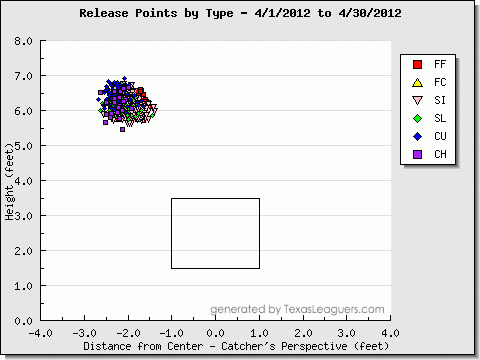
 The graph above plots Arrieta’s release point in 2012. The zone of release points is fairly typical for a right handed pitcher, falling 1 to 3 feet to the left of the mound, and 5.5 to 7 feet above. The wide range of points, especially with the sinker and slider, indicates that he may have trouble replicating his delivery, perhaps why he struggles with command at points. You can see Arrieta’s 3/4 arm slot in the picture on the right.
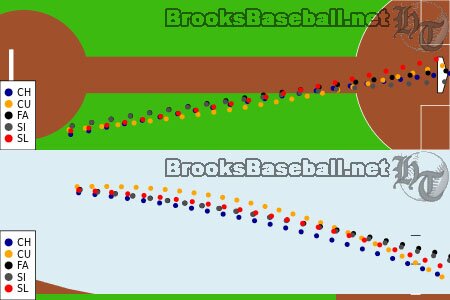
The two images above trace the pitch break of his 5 pitches, from the release point on the left to homeplate on the right. The top image shows a bird’s eye view of the horrizontal pitch break. The sinker, four-seam, and changeup all move in on right handed pitchers, with the slider and curveball breaking away. In the bottom image, the vertical break is shown from a 3rd or 1st base view. The four-seam has the least break, with it’s “rising” action, following by the sinker. The slider and changeup have bigger downward break, with the curveball having the most.
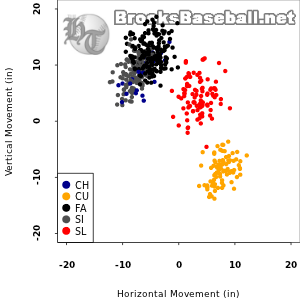
Above, we can better understand the break of each pitch by the plotted horizontal and vertical movement from the catcher’s perspective. The four-seam fastball has an above average 6 inch break into same side hitters, as well as a rise of 11 inches above the no-spin origin. The sinker has more movement in on right handed hitters, 10 inches horizontally, and sat 9 inches above the x-axis. The changeup also moves hard into righties at around 8 inches, with slightly more vertical drop than the sinker at 8 inches above the x-axis. The slider moves horizontally 6 inches into left handed hitters, opposite of the other 3 pitches, but lacks the drop of most major league sliders, sitting at 4 inches vertically. His last breaking pitch, the curveball has the most break down, averaging 9 inches below the x-axis, and has tremendous movement into left handed hitters at nearly 12 inches.
Where he Throws It
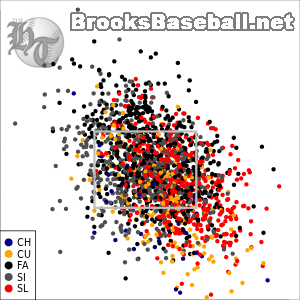
The graph above plots the different pitch types based on location to right handed hitters. While he’ll often attack the zone with both fastballs, he’s more apt to attack in with the sinker, which moves in, and throws the four-seam above the zone to try and draw pop-ups. His curveball and slider, which have movement down and away, are usually thrown down and away to get hitters chasing. In 2012, his selection to righties has been 27% four-seam, 33% sinker, 29% slider, and 12% curveball.

Against lefties, both his fastballs are located away in the zone. The changeup, which moves down and away, is thrown down and away to get hitters chasing. The slider and curveball are located in the same location, this time down and in to lefties to jam them. In 2012, his selection to lefties has been 38% four-seam, 21% sinker, 12% slider, 20% curveball, and 8% changeup.
When He Throws It
| Count | Four-seam (R) | Sinker (R) | Slider (R) | Curveball (R) | Changeup (R) |
| 3-0 | 88% | 12% | 0% | 0% | 0% |
| 3-1 | 61% | 22% | 11% | 6% | 0% |
| 2-0 | 51% | 35% | 14% | 0% | 0% |
| 2-1 | 34% | 30% | 25% | 6% | 6% |
| 1-0 | 39% | 25% | 26% | 9% | 2% |
| 0-0 | 45% | 18% | 23% | 13% | 1% |
| 1-1 | 22% | 28% | 34% | 11% | 5% |
| 0-1 | 31% | 30% | 27% | 13% | 0% |
| 3-2 | 44% | 24% | 26% | 3% | 3% |
| 2-2 | 26% | 28% | 27% | 12% | 7% |
| 1-2 | 35% | 18% | 29% | 14% | 4% |
| 0-2 | 39% | 18% | 32% | 10% | 1% |
Here we have Arrieta’s selection based on count in his career. Starting a count off to righties, he began throwing the four-seam fastball, and mixed in the sinker, slider, and curveball. As he fell behind in the count, he relies on the four-seam, but also increases his sinker usage to encourage groundball contact. After strike one, his sinker increases along with the slider and curveball. After strike two, he will usually throw a breaking ball at a 40% rate, with his four-seam at slightly less. Facing righties, he has a 12% whiff rate on the slider, his goto out-pitch, and a 14% whiff rate on the changeup.
| Count | Four-seam (L) | Sinker (L) | Slider (L) | Curveball (L) | Changeup(L) |
| 3-0 | 90% | 10% | 0% | 0% | 0% |
| 3-1 | 58% | 36% | 5% | 0% | 0% |
| 2-0 | 51% | 33% | 2% | 0% | 14% |
| 2-1 | 30% | 34% | 8% | 11% | 18% |
| 1-0 | 27% | 34% | 3% | 14% | 22% |
| 0-0 | 36% | 29% | 3% | 24% | 9% |
| 1-1 | 21% | 29% | 8% | 21% | 21% |
| 0-1 | 20% | 29% | 7% | 28% | 17% |
| 3-2 | 27% | 27% | 22% | 11% | 12% |
| 2-2 | 28% | 26% | 20% | 15% | 11% |
| 1-2 | 26% | 11% | 30% | 23% | 10% |
| 0-2 | 49% | 14% | 11% | 20% | 6% |
Arrieta starts lefties off mixing his four-seam, sinker, and curveball. As he falls behind in the count, he again becomes reliant on his four-seam and sinker, particularly the four-seam 3-0. After strike one, the righty substitutes some of his four-seam selection with changeups, and after strike two, he finally breaks out the slider for the strikeout. He’s had less success against lefties in his career, with the slider and curveball each drawing a 10% whiff rate.
Results
As a pitcher that mixes four-seams and two-seams, his batted ball rate is 43% groundballs, 39% flyballs, and 18% linedrives. Over his career, he’s shown a 6.08 K/9 and 4.18 BB/9, but this year those numbers have improved to 7.12 K/9 and 2.67 BB/9. An increase in velocity from 92.3 mph in 2011 to 93.3 this year, may be the reason for his early success. Although he has virtually no home/away split, Arrieta has a terrible platoon split facing lefties, who hold him to a .277/.369/.489 triple slash, compared to righties who only hit .231/.304/.343.
Against The Yankees
In 6 starts against the Yankees, Arrieta has pitched to a 4.25 ERA, 1.33 WHIP, and 7.3 K/9. In 3 starts in the Bronx, he has never given up a homerun, and he’s posted a 3.63 ERA, hampered by a 1.500 WHIP and only a 4.7 K/9. Although Jeter, Granderson, and Teixeira have good numbers off him, the entire Yankees team only has 2 previous homeruns off him, both Grandyslams.
| Probable Yankee Lineup | At Bats | Triple Slash |
| SS | 15 | .400/.471/.600 |
| CF | 16 | .313/.353/.875 |
| 3B | 5 | .200/.444/.400 |
| 2B | 15 | .200/.333/.333 |
| 1B | 16 | .375/.444/.500 |
| DH | 2 | .000/.333/.000 |
| RF | 2 | .000/.333/.000 |
| Eduardo Nunez LF | 2 | 1.000/1.000/1.000 |
| C | 9 | .222/.364/.222 |
Prediction
Arrieta currently has a 4.45 ERA, 4.07 FIP, and a 3.79 xFIP, behind some improved velocity and control. His career numbers aren’t brilliant, but there are some changes to his game that could result in success. Usually, the Yankees would send out seven lefty hitters to topple the right handed hitter, but tonight there will only be five, two of which are Chavez and Ibanez. This lineup is far from what we’re accustomed to, but Arrieta’s career numbers don’t scream shutout.
One of the biggest problems we’ve noticed with over the last…forever, really…is his inability to put hitters away once he got to two strikes. It seemed like batters would hit an endless number of foul balls and then take pitches to even the count or get back ahead, and eventually, they’d reach via something hit way too hard for having two strikes. So for last night’s game, I decided to track the results when Hughes got ahead of the hitters, either 0-2 or 1-2, to see how he fared when he got ahead. Of course, I realize now this isn’t exactly scientific without comparing it to his other starts, but this is a jumping off point.
In the first inning, Hughes faced four batters and got ahead 0-2 or 1-2 on all of them. Here’s the sequencing. After falling behind 1-2, saw five pitches. He fouled off three in a row, took a ball to make it 2-2, then struck out swinging. Next, also fell behind 1-2. One pitch later, he grounded out. Third hitter was down 0-2 before taking a ball, fouling off a pitch, and then blooping one into left (at least that’s what John Sterling called it). Like he did with the first two batters, Hughes got ahead of 1-2, but Jones hit the very next pitch, a deep fly ball to right field for an out.
In the second inning, only fell behind, and that was in a 1-2 count. He fouled off one pitch, then hit a tapper back to Hughes.
No one fell behind 0-2 or 1-2 in the 3rd.
In the fourth, Hughes got ahead of Chris Davis 0-2 and then threw two balls and allowed Davis to foul one off before Davis flew out to Eduardo Nunez. dropped down 0-2, took a ball, and then struck out swinging.
The fifth was a repeat of the third.
In the sixth, Nick Markakis fell behind again, then flew out to . Adam Jones also fell behind a second time. He took a ball, fouled one off, took another ball, then grounded out to .
All told, Phil Hughes threw 23 pitches when he was up 0-2 or 1-2 to nine batters. Obviously, nine of those pitches ended the at bat. Six were foul balls. Seven were balls.
Like I said earlier, this isn’t great because I don’t have much to compare these numbers to, but they FEEL better than they’d been in his previous starts. There was some encouragement from this game, as Hughes only walked one and struck out six. But, once again, he couldn’t make it to the sixth inning and surrendered two homers. This start wasn’t great by any means, but it certainly didn’t bury Hughes.
When the Yankees released their lineup this afternoon, I think the collective response was, “Huh?” It featured DHing, with Chris Stewart catching, while and Eduardo Nunez were assigned right and left field respectively. Everything else was pretty normal, but the Yanks’ effort to get as many RHB in against Baltimore starter was for not, as the Yankees could muster just seven hits and one run against Matusz and the bullpen. In fact, only the top three hitters in the lineup– (3), (2), and (2…though one was a bunt single)–had hits. Everyone else was a combined 0-21 with two walks.
There really isn’t much to say about this game. Yankee starter was “meh” (more on him at 9:30 tomorrow morning!) and the Yankees didn’t cash in on the few opportunities they had, most notably in the 7th inning when Rodriguez popped up the first pitch he saw with the bases loaded.
The inning that really did the Yanks in was the 6th. After Hughes was lifted, gave up a single to Chris Davis that moved Matt Weiters, who was on after hit by Hughes’s last pitch of the night, to second base. Next, singled and scored the Baltimore catcher and Davis moved to second. This made it 4-1 with two outs in the seventh, hardly an insurmountable lead for the Yankees. Then, Eduardo Nunez happened. hit a ball to left and Nunez played it horribly at first, then didn’t catch it and was charged with an error. Both Davis and Betemit scored on the error, making it 6-1 Orioles. The O’s added a run in the 8th on a Nick Johnson double, his first hit of the year. In other firsts, D.J. Mitchell made his first big league appearance tonight, so that was cool. Other than that, this is definitely one to forget. Move on from a crappy game and win tomorrow night.
February 27, 2012 is a day that will surely live in infamy in the annals of TYA History. On that day, a scant two months ago, we published our top-prospects lists, yet it seems like only yesterday we were all happily discussing a stout farm system, eager to see the future of the franchise tearing it up in the Minors – naivety at its finest. The perils of youth…
Kidding aside, the end of the first month of the season seems apropos to revisit said prospects – to go back to the future, I suppose. While it represents a somewhat arbitrary endpoint, it does give a somewhat reasonable sample size to work with, as hitters and pitchers alike should have seen a few different looks at this juncture (e.g. different parks, different competition). It also coincides with the time in which promotions tend to kick-off (albeit sluggishly), so it provides for some interesting speculation.
For the purposes of this report, I will focus solely on the prospects that made our combined top-twenty list. If you would like to see different prospects next time around, let me know in the comments or shoot me a message on . And be advised – much of this is quite reactionary.
01. Manny Banuelos – Empire State Yankees, Triple-A
5.1 IP, 14 H, 7 BB, 2 K, 10.13 ERA, 8.83 FIP
There really isn’t anything pleasant to say about Banuelos’ abbreviated month of April, nor is there any semblance of a silver lining. It appears that durability is going to be a ubiquitous concern with Banuelos, as he has been on the disable list since April 13th with a lat strain (which was supposed to keep him out for one start) – and while he hasn’t had any grievous issues with his arm or shoulder, he has missed time every year with minor, nagging injuries, and his size does not lend confidence in this regard.
I remain excited about Banuelos’ talent and impressive ceiling, particularly as he refines his , but there is some cause for concern here.
02. Gary Sanchez – Charleston RiverDogs, Low-A
.346/.407/.462, 0 HR, 6 SB, 148 wRC+ (86 PA)
Sanchez’s performance thus far is all but diametrically opposed to Banuelos’. With the exception of his power numbers (which are the least of anyone’s worries), Sanchez has been strong across the board this season … and that includes his defense behind the plate. Keith Law wrote a bit about the Charleston RiverDogs after taking in a game, and he found that “[h]is defense was a pleasant surprise, as he’s substantially improved over where he was last year in both receiving and throwing.” The general sentiment with Sanchez’s defense seems to be that he will have to work his ass off to stick at catcher, but the potential is there – and that’s more than most were saying about the dearly departed Jesus Montero at a similar age. Continue reading »
Baseball America is in the business of prognostication, or, perhaps more accurately, semi-scientific soothsaying (which is a fine explanation of ‘SSS’ to those you’d like to mock). Their projections, not unlike those of most any prospect analyst or scout, are inaccurate far more often than not – meteorologists may well scoff at the B.A. Handbooks of yesteryear without a hint of irony.
Regardless, despite the inherent flaws associated with gazing into one’s prospecting crystal ball, few argued with Baseball America’s assessments of Messrs Hughes and Matusz, both of whom peaked in the outlet’s top-five – Hughes at number four in 2007, and Matusz at number five in 2010. Over the course of their respective Major League careers, the duo has combined to throw just over 750 IP … while posting a 4.99 ERA and 5.8 bWAR (4.6 of which, it must be said, belongs to Hughes).
The 2011 season represented rock-bottom for both (though, that may be optimistic given Hughes’ performance thus far), with questions of talent, dedication, and most everything involving the human condition flying in from all directions. Spring Training, however, resulted in renewed hope for the duo, with reports of improved velocity and command flowing for both, and “best shape of his life” sentiments being expressed with gusto. Neither has fulfilled the promise of early Spring, but both remain 25-years-old … and tonight represents a snapshot into the perils of prospecting. For those of us who concern ourselves with such efforts, this is nothing short of intriguing.
Onto tonight’s line-ups:
| Baltimore Orioles | New York Yankees |
| Endy Chavez, LF | Derek Jeter, SS |
| J.J. Hardy, SS | Curtis Granderson, CF |
| Nick Markakis, RF | Alex Rodriguez, 3B |
| Adam Jones, CF | Robinson Cano, 2B |
| Matt Wieters, C | Mark Teixeira, 1B |
| Chris Davis, 1B | Andruw Jones, RF |
| Wilson Betemit, 3B | Russell Martin, DH |
| Nick Johnson, DH | Eduardo Nunez, LF |
| Robert Andino, 2B | Chris Stewart, C |
| Brian Matusz, SP | Phil Hughes, SP |
The first pitch is scheduled for 7:05 pm, on YES – let’s go Yankees!
Throughout his Yankee career, Boone Logan has been the recipient of (what is, in my opinion) a disproportionate amount of criticism, not only for his performance, but also for his handling. Much of the disappointment with the failed Javy Vazquez trade (version 2.0) seems to have been projected upon Logan, a talented albeit limited pitcher who was not always deployed optimally by Joe Girardi (facing too many righties, in particular).
While people with selective memories like to remember the times where Logan has failed, the fact is that throughout his Yankee career, Logan has been a very effective reliever. How effective? In 91 career innings for the Yankees, Logan has surrendered 30 earned runs (good for an ERA just below 3), struck out 97 (9.6 k/9), and walked 38 (3.8 per 9). These are very good numbers for any reliever, much less a guy who is never more than the 4th or 5th option for setup duty.
Over his career Logan has become not only an useful piece of the Yankee bullpen, but a major asset. He has been absolutely dominant in 2012. Though Logan has faced same-handed hitters more frequently, he has improved against righties to the point where he can be adequate against them. On the season, Logan has given up just 1 run on 6 hits and 5 walks, with a whopping 13 strikeouts in 9 1/3 innings. His k/9 of 12.54 on the season is approaching David Robertson territory, and while his walk rate is higher than you would like to see (4.82/9), it is not a deal-breaker if he is able to keep limiting the number of hits and home runs he allows and keeps the strikeout rate up. Obviously it’s a small sample size and one or two bad outings could change his numbers dramatically, but Logan’s performance in 2012 has been very impressive.
How has he been getting it done this year? As in the past few years, he has primarily used a fastball touching the mid-90′s (averaging 93-94) and a slider in the low-80′s. One thing that is noticeably different is Logan’s pitch mix. Boone threw the heater 67 percent of the time in 2010, and 62 percent of the time in 2011. In 2012, that number has dropped to just 48 percent. He has replaced most of those fastballs by throwing more sliders, which are easily his best secondary offering. So far he has used the slider 46 percent of the time, compared to 36 percent in 2011 and 26 percent in 2010. The increased featuring of the slider could explain why Logan is striking batters out at such a high rate this year. Logan is also using his changeup more than in previous years, up to over 7 percent of pitches (compared to about 5 percent in 2011, and 2 percent in 2010).
His pitches, according to pitch f/x, don’t appear to be very different as far as velocity and movement go, but perhaps their combination is responsible for Logan’s dominance this year. Boone’s whiff rate (per Brooks Baseball) is noticeably higher for his secondary offerings than it has been in previous seasons. The whiff rate on Logan’s slider jumped from 23 to about 30 percent between 2011 and 2012, and the changeup from 19 to 33 percent over the same span.
It may be a lot to ask for Boone Logan to maintain his current level of performance, but given his body of work over the last 2+ seasons, he should continue to be a valuable contributor to the Yankee bullpen. He can be frustrating to watch at times, but because of his track record of success in a Yankee uniform, I will continue to defend him to the naysayers on Twitter who bash him for giving up a leadoff single. He is not the best reliever on the Yankees, but as lefty relievers go, there aren’t too many that have been better than Logan over the past 2+ years.
(The following is being syndicated from An A-Blog for A-Rod)
The lack of production from the middle of the Yankee lineup this season is a theme that probably deserves more time and space to discuss than it’s gotten so far. There have been a few big games here and there, but in general the trio of , , and has been pretty mediocre, and lucky that the rotation has been even worse. For guys like A-Rod and Teix, with injury histories, track records of slow starts, and swing/approach adjustments that they’re focusing on, the slow start can be understood to a degree. For Cano, however, his sluggish start comes as a surprise. This is a guy who hit .320/.340/.639 last April and has a .294/.335/.480 slash in the season’s first month in his career, and yet currently sits at .264/.323/.391 (.312 wOBA) 96 plate appearances into the season. A glance at Cano’s peripherals to try to explain this slow start makes the situation all the more confusing.
With Cano, the logical first place to start when investigating problems is his selectivity. Cano has always been a free swinger with a low BB rate, and those things tend to manifest themselves as bigger problems in his game when he’s slumping. This has not been the case this year, as Cano’s current BB rate of 8.3% is consistent with where it was in his banner year of 2010. He’s also sporting a minute 7.3% K rate, indicating that Cano isn’t flailing away and missing at a lot of pitches. His PITCHF/x Swing Rate of 46.0%, O-Swing Rate of 25.6%, and SwStr Rate of 6.2% are also lower than they usually are for Cano, significantly lower in the case of the Swing Rates, and support the theory that Cano has been more selective and less swing-happy at the plate this year. In theory, a hitter of Cano’s caliber should have much better numbers with across-the-board improvements in the swing/take department. Something’s not adding up here.
The smoking gun can be found in Cano’s contact splits, which are way off from where they usually are. His LD rate of 21.0% is solid, and actually 2nd only to the LD rate he posted last season in terms of career rankings, but his GB/FB splits are drastically different than what Cano historically puts up. Cano’s GB rate is 54.3%, which would be a career high for him and the first time he’s posted a GB rate above 47.4% since 2007. His FB rate of 24.7% is also alarmingly off from Cano’s usual breakdown, and it would be the first time since ’06 that Cano finished with a FB rate below 30.0%. The solid LD rate combined with Cano’s extremely low .275 BABIP can speak to the existence of some bad luck here and there, but the drastic shifts in GB/FB ratio suggests something more than that.
As bad as Cano’s general contact rates are, the GB splits to all fields are even worse. Cano is hitting 51.5% of his balls in play to center field on the ground, and an astounding 73.3% of his balls in play to right field on the ground. This has led to a .291 wOBA to center so far and a .272 wOBA to right, both of which are well off of Cano’s career values in those departments (.373 career wOBA to center, .417 to right). Suddenly, Cano has gone from a guy with power and contact skills to all fields to a reverse left-handed Mark Teixeira; he’s doing damage hitting the ball the opposite way to left, but has been much less effective to center and even worse to the pull side where he’s rolling over and hitting everything into the ground.

(Courtesy of TexasLeaguers.com)
To tie these two seemingly unrelated topics together, let’s go back to the pitch selection. The increased BB rate and decrease in Swing rates suggest that Cano has gone back to what made him so successful in 2010 and focused on taking more pitches and swinging at fewer bad ones. That should result in more pitches seen per plate appearance, but check that stat and you’ll see that Cano is averaging just 3.375 P/PA. Whether you’re a hitter who prides himself on working counts or a hacker, 3.375 pitches per PA is low, and it makes Cano’s numbers even more difficult to explain.
This brings me to a point in Sunday’s game, I believe during Cano’s 2nd AB, when and Ron Darling discussed Cano’s poor start and talked about the changes in approach that pitchers were taking with Cano. According to them, word around the AL is that throwing Cano hard inside early and making him move his feet takes him out of his comfort zone a bit and allows pitchers to attack him more away with their offspeed stuff. Sure enough, the next pitch to Cano was way inside and he had to dance back to avoid taking a pitch off the thigh. Now he ended that at-bat with a single, but checking the pitch location breakdown, there might be something to that theory.

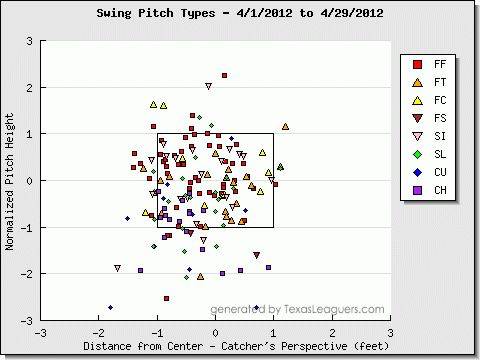
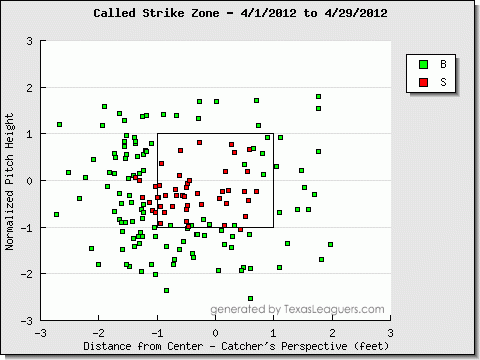
There aren’t a ton of inside pitches shown in the charts above, but there is a smattering of fastballs inside, almost all of them taken, and a lot of pitches to the outer half and beyond that lend credence to this approach being real.
This is a bit convoluted, but adding all these pieces up, here’s what I believe is happening to Robbie. Pitchers are making an adjustment to Cano’s zone coverage skills and trying to pitch him in early, even if it’s not a strike, to set him up away. Cano is attempting to combat this approach by laying off more pitches on the outside, and sometimes drawing himself walks in the process as a result of pitchers showing him respect and opting to walk him if they miss outside rather than groove a fastball for a strike. But as a free swinger, Robbie’s belief is he’s up there to swing the bat and hit the ball, so when he does get a pitch early in the count to hit, he’s taking his hacks, knowing that it might be the only time in the at-bat that he gets something good. Perhaps some of those pitches aren’t exactly where he wants them and perhaps he’s getting a bit antsy on the outside and rolling over on those pitches, creating the spike in groundballs that we’ve seen from him thus far and sapping his power to center and right field. In his attempt to adjust to pitchers adjusting to him, Cano has basically started doing what he never used to do- swing at bad pitches to hit and make weak contact.
Robbie has always been a hitter with a relatively even contact breakdown and the ability to hit to all fields well. It’s what’s made him so dangerous and allows him to be one of the few Yankee lineup regulars who can consistently be labeled as a big threat regardless of what hand the opposing pitcher is using to throw the ball. That hasn’t been the case early on in 2012. Whether it’s in response to a change in approach from opposing pitchers, some mechanical flaws in his swing, bad luck, or a combination of everything, Cano is not hitting up to the level we’ve come to expect. He seems caught in the middle on how to adjust his game to fix the problems and nothing like the version of himself that we know and love. There hasn’t been a whole lot of chatter from Joe, Kevin Long, or Cano himself about what’s going on, but a few more weeks of numbers like this and it might be time to rethink his current strategy.
(All pitch graphs courtesy of Texas Leaguers)

Recent Comments